How a Road Changed Mount Hood Forever
In the early 20th century, long before travelers zipped up Highway 26 to ski lifts and mountain resorts, a trip to Mount Hood was a full-day expedition. The road, built upon the bones of the old Barlow Trail, was steep, narrow, and often rutted beyond recognition. Depending on the season, it was either ankle-deep in dust or swallowed in mud.
For those without their own wagon or automobile—and even for many who had one—the journey meant placing your trust in the hands of professional stage drivers who knew every rut, rock, and river crossing by memory.
This was the era of mountain stages.

The Road Before the Road
Before the 1880s, travel followed the original Barlow Trail, carved out by immigrant wagon trains in the 1840s. That route passed over the shoulder of Laurel Hill—an infamous descent that challenged even the most determined settlers, and over the Devils Backbone, a ridge separating the Sandy River and the Little Sandy River and then to the Willamette Valley.
By the 1880s, a new south-side road connected Sandy to Government Camp along the Sandy River. It offered slightly gentler grades, and it quickly became the preferred route for travelers and freight alike.
The main mountain road now passed through Sandy, Cherryville, Brightwood, Wemme, Welches, Zigzag, Rhododendron, and on to Government Camp. Along the way stood the Cherryville Hotel, Welch’s Hotel, the Rhododendron Inn, and other early lodges that depended entirely on arriving stages.
The mountain was no longer a barrier to travel. It was becoming a destination.

The Horse-Drawn Stage Era
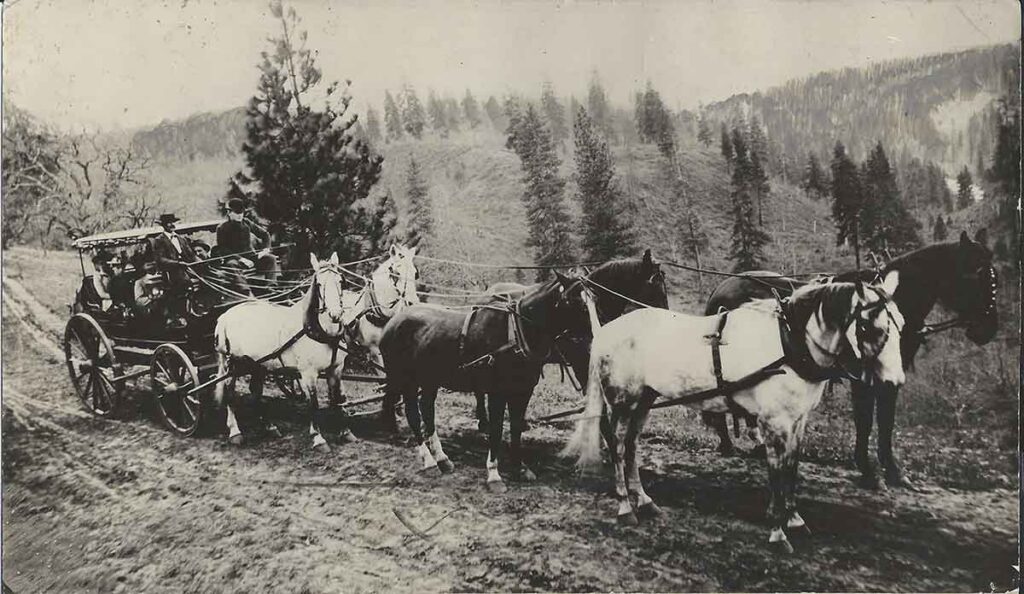
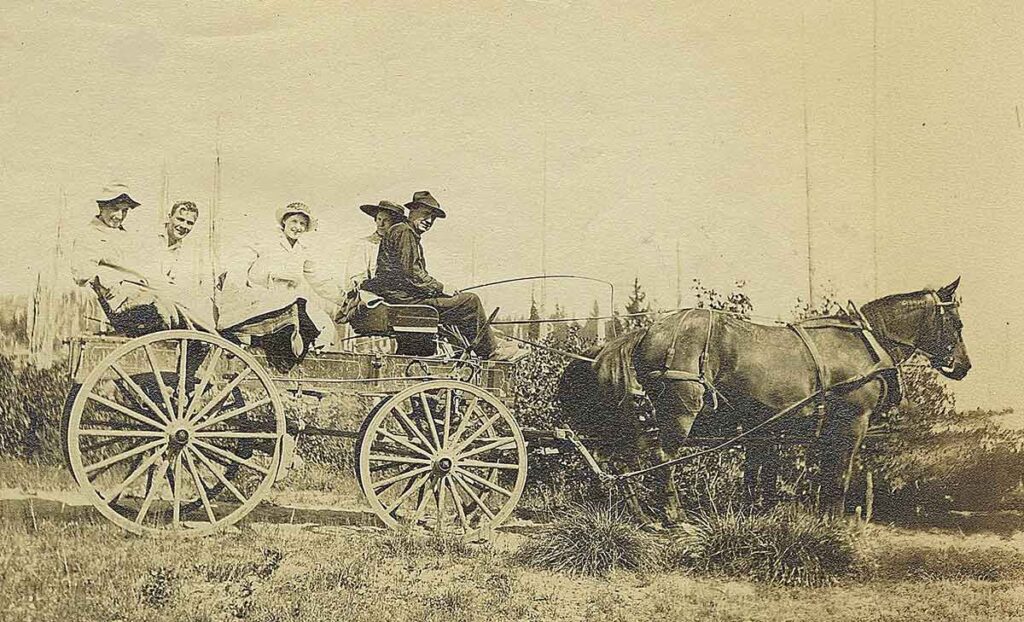
In the late 19th century, local drivers like Joe Meinig and Walter Ziegler operated horse-drawn stages between settlements. These were not leisurely rides. Teams strained on steep grades. Passengers sometimes disembarked to lighten the load. River crossings were unpredictable.
Travel required patience—and faith in the driver.
But tourism was growing. Portland residents wanted summer mountain air. Hunters, fishermen, campers, hikers and climbers wanted access to the south side of Mount Hood and its foothills. The hotels and roadhouses advertised the activities within reach of their establishments.

When Horses Met Horsepower
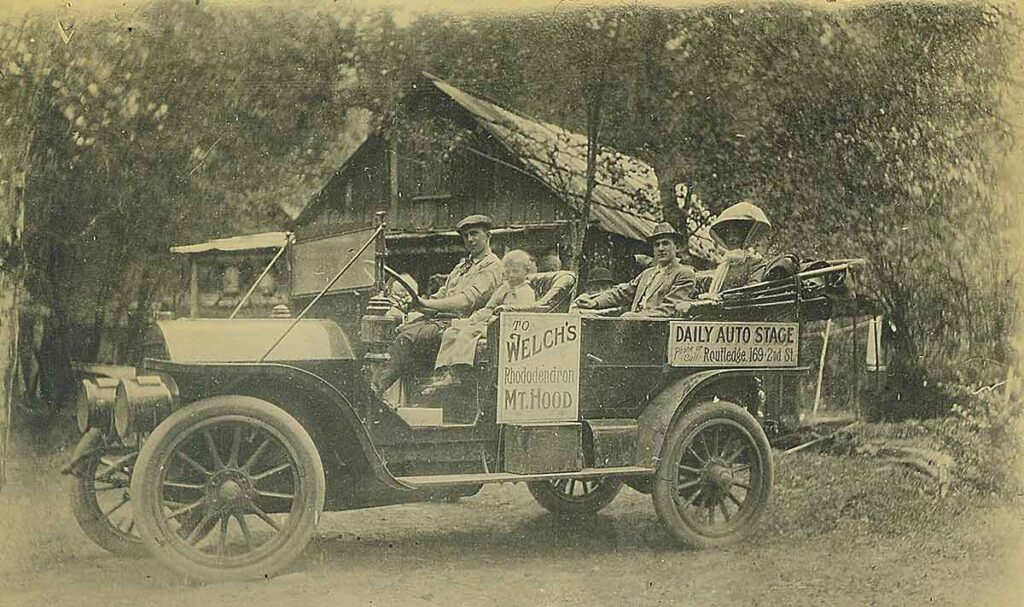
By the early 1910s, something new appeared on the mountain road: the motor stage.
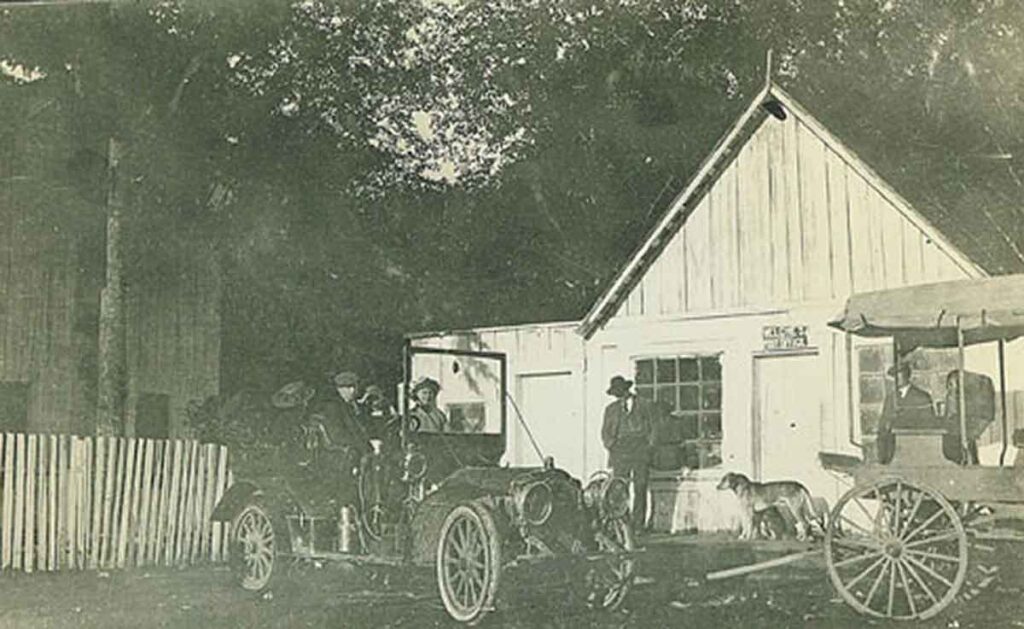
At first, automobiles shared the road with horses. Engines sputtered and overheated. Tires punctured constantly. Passengers still walked steep hills. Drivers carried chains, tools, spare tires, and a mechanic’s instincts.
Reliance Stages in East Portland and Sandy garage owner Bob Elliott were among the early operators running motor stages to Government Camp. Vehicles such as Pierce-Arrows, White touring cars, and Cadillacs were modified to survive the grades. Some pulled freight trailers. Others carried canvas tops to shield passengers from sun and sudden mountain storms.
One of the most vivid chroniclers of this era was Dr. Ivan Woolley, whose memoir Off to Mt. Hood remains one of the best accounts of early mountain travel. Woolley described dust clouds hanging in the timber, mechanical breakdowns miles from help, and the cast of characters who rode the daily stages. Much of what we know about this transitional period survives because he took the time to record it.
This was a hybrid age. Horses had not fully disappeared. Automobiles had not yet conquered the mountain. Both struggled against a road never designed for engines.
Hills That Stopped Progress
The limitations of the old wagon road became increasingly obvious.
Laurel Hill remained treacherous. McIntyre Hill at Brightwood was so steep that hotelier John McIntyre reportedly hauled stalled automobiles to the top for a fee. Washouts were common. Spring runoff damaged bridges. Freight wagons and automobiles competed for space on narrow grades.
Travel demand was increasing faster than infrastructure.
By the 1910s, Mount Hood tourism was no longer a novelty. It was an industry. Resorts depended on reliable access. Portland investors promoted the mountain as a playground. The automobile had changed expectations.
People wanted speed. They wanted comfort. They wanted predictability. The old Barlow Road could not provide it.

The Scenic Highway Movement
Meanwhile, a revolution in road engineering was unfolding along the Columbia River.
The Columbia River Highway, completed in stages between 1913 and 1922, demonstrated what modern engineering could achieve. Designed for automobiles, it featured gentle grades, reinforced bridges, and scenic viewpoints built intentionally for motorists. It was not just a road. It was a statement about the future of travel.
If such a highway could be built along the cliffs of the Columbia Gorge, why not a modern route around Mount Hood? Momentum began to build for a complete redesign of mountain access.
The Mount Hood Loop Highway
By 1925, the Mount Hood Loop Highway had been completed, smoothing out the worst grades and replacing the most dangerous sections of the old wagon road. With the section to Government Camp, the section on the east side of the mountain connecting to Hood River and then along the Columbia River Highway through the Columbia River Gorge, they all formed a complete loop around the mountain.
The transformation was immediate. With improved roads and increasingly affordable, reliable and faster automobiles, tourists began driving themselves. The commercial stage lines—horse and motor alike—rapidly declined. What had once been essential transportation became obsolete almost overnight.
The mountain was no longer a distant excursion. It was a weekend drive.
The End of an Era
The era of the mountain stage lasted barely a few decades, yet it marked one of the most dramatic transitions in Mount Hood’s history. Within a single generation, travel shifted from animal power to engineered highways.
The old Barlow Road had carried settlers west. The stages carried tourists up. The Loop Highway carried the future of the mountain. And in doing so, it forever changed the pace—and purpose—of travel to Mount Hood.
