

Illuminating a Mountain
Illumination Rock Mount Hood history – In the late 19th century, Oregonians became fascinated with the idea of lighting up Mount Hood so brightly that it could be seen from Portland. These early “illuminations” captured the imagination of climbers, civic leaders, and mountain clubs for nearly a century. The effort gave Illumination Rock its name and left a unique tradition on the mountain.
Perry Vickers and the First Attempt
The earliest recorded attempt came in 1873, when Perry Vickers—Mount Hood’s first permanent resident—hauled magnesium up the slopes. Vickers had already been hosting bonfires for locals at Summit Meadows, but this time he hoped to send a signal all the way to Portland. The magnesium blazed brightly and impressed those nearby, but the light failed to reach the city.

Success on the Fourth of July, 1887
For years, other climbers tried and failed. The breakthrough came on July 4, 1887, when Portlanders George Breck and Charles H. Grove ignited a blaze that was finally visible in Portland. Their success named Illumination Rock, the craggy outcrop near the summit where the fire was set. Among the party were notable figures: conservationist William G. Steele, mountain guide O.C. Yocum, Dr. J.M. Keene, and Dr. Charles F. Adams.
Heliographs and Flares in the 1890s
The fascination continued into the 1890s. A group of climbers experimented with heliographs—mirrors meant to flash sunlight from the summit down to the city. The idea drew interest, but the flashes proved too faint for consistent visibility. Other parties tried flares and torchlight in the late 1890s, including a reported illumination in 1899, but results were mixed.
The Lewis and Clark Exposition Attempt
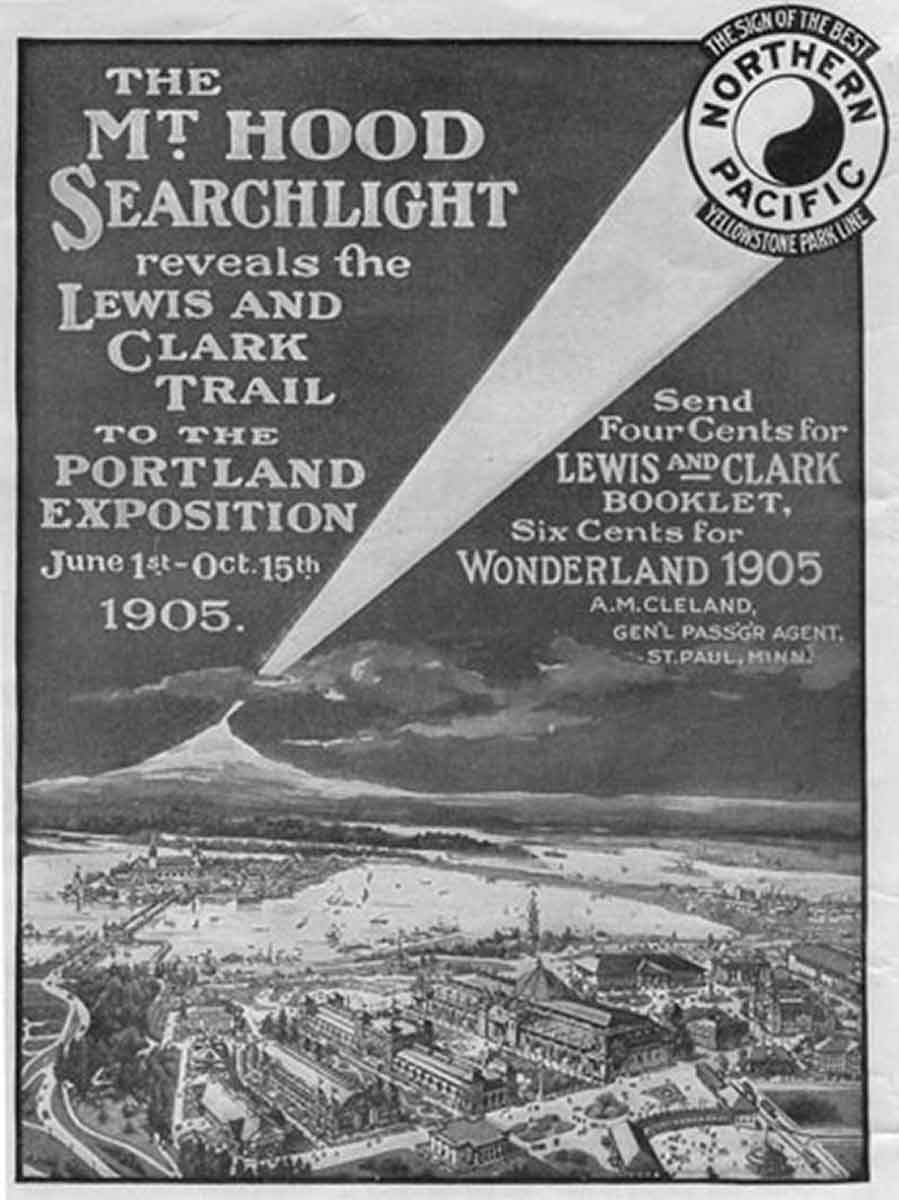
When Portland planned the Lewis and Clark Centennial Exposition of 1905, some dreamed of grand summit lights. Organizer W.M. Killingsworth even floated the idea of illuminating two giant statues—Lewis on one side of the mountain and Clark on the other—powered by electricity from nearby streams. The concept was impossible to execute, but “Plan B” was set in motion.
On July 4, 1905, a party climbed Cooper Spur and lit red powder on the summit. Strong winds scattered the flame, and Portland saw nothing. Yet reports from Hood River Valley confirmed a glow on the mountain that evening.
Keeping the Fires Alive
The Mazamas and other clubs kept the illumination tradition alive in the 20th century. In 1915, climbers staged a summit fire that was seen across the region. During the 1930s, winter sports events featured torchlight skiing and summit flares. The Wy’east Club held its own illumination in 1932, continuing the ritual into a new generation.
The Grand Finale
The most spectacular display came in 1969, when the Mazamas celebrated their 75th anniversary. Fires blazed across the summit in a coordinated effort that could be seen from miles away. It was a fitting tribute to nearly a century of mountain lights.
A Legacy in Stone and Story
Today, Illumination Rock stands as a reminder of those efforts. What began with Perry Vickers’ bonfire in 1873 grew into a long tradition of ingenuity, celebration, and spectacle. Though the lights no longer blaze, the name remains as a prominent feature on Mount Hood.